The biggest, new concept I learned in week 4 was how to design restriction enzymes and perform a digestion reaction. Up until now, most of the procedures in the lab had just been protocols that I could follow step by step. There was no protocol to designing restriction enzymes. It required looking at plasmids maps of multiple plasmids, looking at the sequences to make sure that the enzymes I chose were not too close to the gene we needed to cut but also not too far. There should only be one of those enzymes in the whole plasmid, that way it increases specificity and our chances of success.
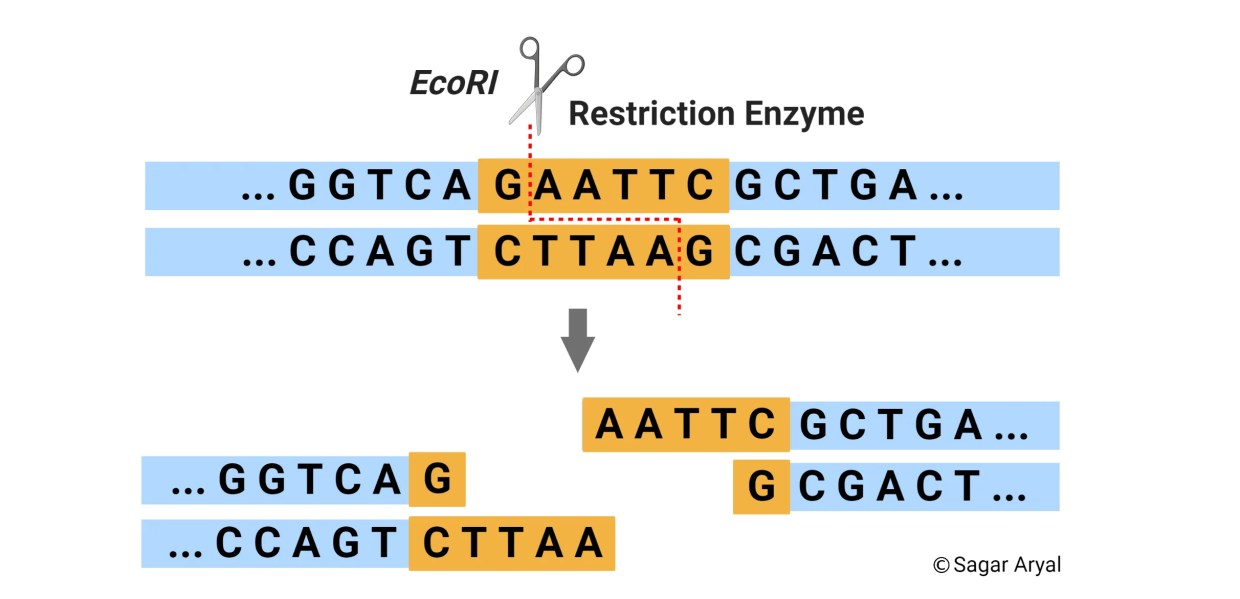
The first major step was learning how to choose restriction enzymes, which are basically molecular scissors that cut DNA at very specific sequences. The goal was to move a piece of DNA, called the insert, from one plasmid into another plasmid. To do that, the DNA needs to be cut in just the right places so the insert can fit cleanly into the new plasmid like a puzzle piece.
To figure this out, we uploaded the DNA sequences for both the insert and the plasmid into a program called Benchling. Benchling is like a planning tool for molecular biology. After choosing your enzymes, Benchling will simulate what the cut will look like and you can make a decision based off of the result Benchling spits out. It took some trial and error, but eventually I picked enzymes that worked.
When choosing restriction enzymes, there were several rules we had to follow. First, the enzyme had to cut only once in the insert and only once in the plasmid. If it cut more than once, the DNA would be chopped into too many pieces and become unusable. Second, the cut sites needed to be on both the insert and the plasmid, otherwise the pieces would not match up later. Third, the enzymes needed to cut around the insert, not inside it. Cutting inside the insert would destroy the DNA sequence we were trying to keep. Finally, the cut sites could not be too far away from the insert because that would add extra, unnecessary DNA.
Benchling made this process much easier. By running a simulated digestion and using the assembly wizard, we could see whether the insert would fit into the plasmid after cutting. This was one of the most helpful tools because it showed the entire cloning process visually, which made it easier to see what was supposed to happen before actually doing it in real life.
For our project, we were moving DNA from pCR2.1-TOPO into pMIG II, and the restriction enzymes we chose were BamHI and XhoI. These enzymes followed all the rules and created matching ends on both the insert and the plasmid, which is exactly what we needed.
Once the enzymes were chosen, it was time to perform a double digestion, which means using two restriction enzymes at the same time to cut the DNA. This part required careful calculations. We had to figure out how much DNA, enzyme, buffer, and water to add so the reaction would work properly.
Gel electrophoresis is basically how we check whether the DNA was cut the way we planned. When we digest DNA with restriction enzymes, we are cutting it at very specific spots. Before even running the experiment, we can calculate how long each DNA piece should be after the cut, measured in base pairs. Those numbers come from knowing exactly where the enzymes cut on the plasmid or insert. So we go into the digestion already having a prediction in mind.
When we run the digested DNA on a gel, the gel separates DNA pieces by size. Smaller pieces move farther down the gel, and bigger pieces move more slowly and stay closer to the top. This matters because where a band shows up on the gel corresponds to the length of that DNA fragment. We also run a DNA ladder next to our samples, which has fragments of known sizes. That ladder acts like a ruler, letting us estimate how long our DNA fragments are by comparing how far they traveled.
If the digestion worked, the bands on the gel should line up close to the sizes we calculated beforehand. For example, instead of seeing one large band from an uncut plasmid, we should see two separate bands that add up to the original length of the DNA. If the gel shows the expected number of bands at roughly the right sizes, that’s a good sign that the enzymes cut where they were supposed to. If the gel looks smeared, has too many bands, or still shows one big uncut band, that usually means the digestion did not fully work or something went wrong during the reaction or the gel run.
The first time we ran the digestion and gel, the results were not great. The gel looked off, and it seemed like the DNA might not have been properly digested. The gel may have been overrun, or the enzymes may not have worked as expected. No worries, this is just part of research.
We followed the same protocol but left the digestion in the incubator overnight at 37 degrees Celsius to give the enzymes more time to work. The next morning, we had to inactivate the enzymes so they would stop cutting. XhoI was inactivated by heating the sample to 65 degrees Celsius for 20 minutes. BamHI was inactivated later when we added the loading dye, which contains SDS that stops the enzyme from working.
This gel doesn’t look too promising either…
Oh well, we’ll have to troubleshoot and figure something out next week.